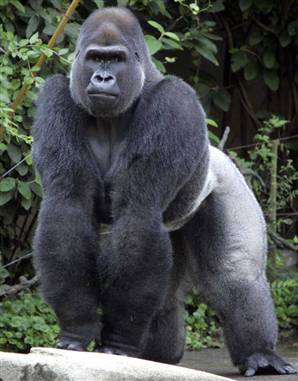
The two species that I’ve chosen that poses a homologous trait are the Blue Whale and the Gorilla. The Blue Whale is a marine mammal and the largest animal ever known to have existed measuring at approximately 108 ft. long and weighing in at about 200 tons. The Gorillas are the largest species of primates, whose closest relatives are chimpanzees and humans, and natural habitats consist of the tropical/ subtropical forests of Africa.
The homologus trait that they both share is the flipper of the Blue Whale and the arm of the Gorilla. The Gorilla arm and the Blue Whale fin are structured similarly; the humerus bone is attached to the radius and ulna bones which are connected to the carpals, metacarpals and phalanges, however the function of these arms are used differently by both species. The Blue Whales flipper is short, flat and paddle shaped and is used to help them move through the water and keep them balanced. The Gorillas arm is long, large and muscular because Gorillas use them as walking limbs although they are capable of walking upright. Although the limbs of both species are superficially different, the underlying structure is very similar.
Both of these mammals inherited their limbs and evolved from a common ancestor, which was the first Tetrapod, which existed around 350 million years ago. We know that Tetrapods possessed limbs due to many fossils that have been discovered. From here we see that the tetrapod evolved to land walking creatures that future species would later use this limb as an arm to grasp and hold objects and the other creatures went towards the ocean and used them as tools to help them navigate through water.



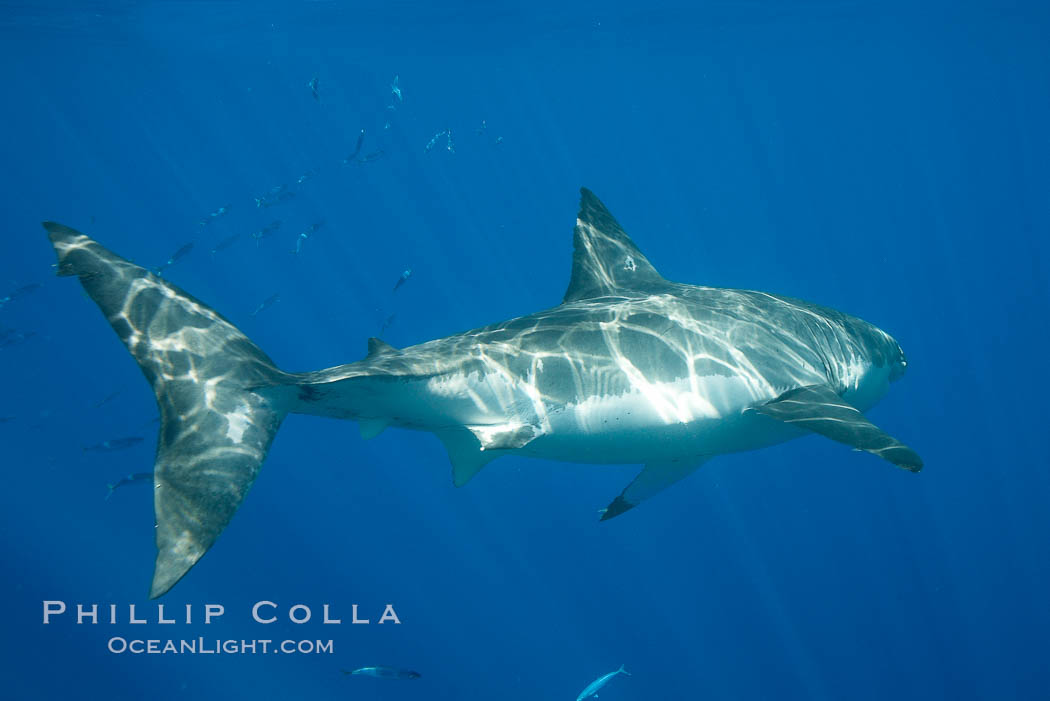
The two species that I have chosen that share an analogous trait is the Bottlenose Dolphin and the Great White Shark. The Bottlenose Dolphin is a mammal that resides in the ocean in warm temperate waters and is known for considerable intelligence. The Great White Shark is a large shark that resides in most major oceans and can be found in coastal surface waters, mostly known for its size and association with Steven Spielberg’s film Jaws.
The possible common ancestor that theses species have is the Myllokunmingia, which is believed to be the first vertebrae, which was in existence about 524 million years ago. From here, evolution from these beginnings lead to the species we are familiar with today such as bony fishes, birds, frogs and mammals. Skeletal elements of the animal suggest that it had a skull a long dorsal fin. This was not at all like what the Bottlenose Dolphin and Great White shark have today put the rear tip of the animal was used similarly (to thrust and glide through water) to the species which we’ve compared.