Tuesday, May 31, 2011

Human Variation and Race


High altitude is an environmental stress that negatively impacts human survival. Higher altitudes affect the homeostasis of the human body due to the lower air pressure at those heights, even though the 21% oxygen level is the same at both higher altitudes and sea levels, equally. There are also higher risks of dehydration that can lead to edema, which is back up fluid that has built up in the body from dehydration, which causes the appendages of the body to swell. Dehydration is a common problem in higher altitudes because the evaporation rate of moisture in the skin and in the body, such as the lungs, is faster than at sea level. This is why staying properly hydrated in high altitudes is extremely important, as extreme cases of dehydration and edema can lead to death.

An example of short-term adaptation to high altitudes is increased breathing and heart rates. Increased and faster breathing is a result of trying to obtain more oxygen from the lower air pressure. This is because the lower air pressure distributes the oxygen molecules further apart, which causes less oxygen inhaled in each breath. The faster breathing then increases the heart rate, which pumps blood and oxygen to the rest of our bodies. This adds higher levels of stress on the heart as it works harder to distribute oxygen to the body.

A facultative adaptation is the increased red blood cells count in the human body. This is in compensation of the difficulty in obtaining oxygen in the body, so the higher blood cell count increases so it is easier for the body to produce more oxygen. The capillary count also increases to provide the same effect as the red blood cells. The lungs and vascular muscles also are forms of facultative adaptation as they expand and enlarge in order to properly distribute gases.

An example of developmental adaptation is the change of DNA over time and due to natural selection. Certain indigenous populations in Peru have, over time, altered their DNA to produce higher hemoglobin levels in their blood, which allows for increased amounts of oxygen being distributed to the rest of the body. This is possible due to the faster breathing rates, which are a direct result of the higher hemoglobin levels. The changes in this particular group of people has been established and inherited over 3,000 years living at altitudes of 13,000 feet above sea levels.

Cultural adaptations used by some populations to assimilate to living in higher altitudes can be in the form of many things, such as diet change. As previously mentioned, higher altitudes produce higher risks of dehydration, some groups of people have increased water intake to account for this. Some even produce and incorporate certain devices such as breathing masks to assist in breathing in higher altitudes.
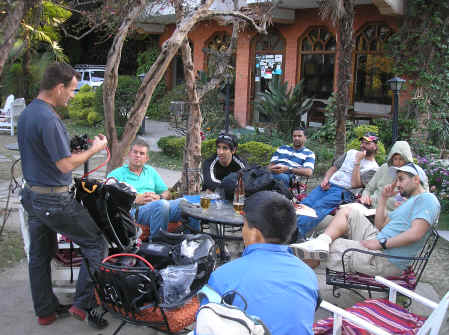
Team receiving instructions on oxygen masks

The benefits of studying human variation from this perspective across environmental clines are to see how and why populations living in higher altitudes experience longer lives and lower percentages of heart disease. It is possible that the higher altitudes strengthen the heart due to the hearts increased work and exercise required to pump blood and evenly distribute oxygen to the body, this results in increased heart stamina and longer endurance. I read an article that also suggests that people looking to train for long distance running or swimming would be better equipped for sea level challenges if they train in higher altitudes as the extensive heart and breathing stamina acquired would result in heightened endurance.
I do not believe that race should be used to understand the variation of people and their short term, facultative, developmental and cultural adaptations to their surroundings because the findings would not be accurate. There are many variations in any given race; therefore relying on one individual or individual group to account for an entire society would be inaccurate and false. Our genetic make up is relatively the same, across the board for all races, so we would all react similarly to environmental stressors, regardless of race. Viewing and researching the environmental influences and the populations’ adaption to these stressors would be a much more accurate determining factor of the environmental effects on humans, as the location and those particular environmental effects would conclude in specified results.

Wednesday, May 25, 2011

Language Communication


            My language assignment experiment was conducted at a coffee shop with two close friends. To assert some sort of structure, I decided that there should be a singular topic for the conversation, we decided on trying to communicate what we would be having to eat and drink from that particular coffee shop. Needless to say, it was very difficult being in a group where speech facilitated communicating the individual needs of each person except in my case, as I had to rely on extenuating means to convey the same message. My friends easily described exactly what they wanted; even specifics were discussed such as “low fat milk” and “toasted” bagels, all within a matter of seconds. I was faced with a long and frustrating pantomime display in order to simply request tea, obviously, the particulars of the tea being hot or cold and which was my flavor of choice, where harder to express without using speech, and were vaguely understood among my group.
            My friends found the communication interaction in the first round just as frustrating as did. My lack of speech forced them to alter their communication skills requiring them to recompose how they understood what I wanted, as they could no longer rely on my verbal cues.  One of the things that became apparent almost immediately was the role of assistant, as they each took it upon themselves to guess what I was trying to convey. Towards the end of the 15-minute time period they seemed to be getting increasingly frustrated and would quickly guess as to what I was trying to express, whereas as in the beginning, they allowed me to fully “explain” what I wanted. A positive change in their ways of communication skills was the understanding of certain “words” that slowly developed. For example, the word for “warm” was transformed into a new hand sign that I developed when initially trying to express that I wanted warm tea. In the last minutes of the allotted time, when things that needed to be described as “warm” presented itself, it was quickly understood and the conversation would progress to the next defining word.
            If I were to imagine that my group was 3 separate cultures trying to communicate complex ideas, I would say that the advantage would be to the group(s) that communicates in verbal speech that can be comprehended by the other parties. Although, as I noticed with my friends, communicating one’s needs requires some sort of validation that there is an understanding of what is being requested, aside from the immediate result of what is wanted. Normally, we rely on verbal cues of “I understand” or similar reaffirmations of comprehension, however when faced with a party that cannot express this verbally, the speaking party is initially unsure if their statement was adequate enough to convey their concepts. So in terms of different cultural parties trying to express complex ideas to a nonverbal party, they do not have as simple of a task as would one would initially assume. They are also presented with a frustrating situation when these complex ideas are not easily formulated and therefore trying to decipher what the nonverbal party is trying to communicate is extremely difficult. Not being to understand speech, or a lack thereof is just as difficult as not speaking. The speaking party has to fill holes in the communication interaction that may or may not be correct, and if they are indeed incorrect, the person must start from scratch without any constructive criticism as to how closely they initially understood the proposed idea. Commuting those same needs without verbal cues however, pose a completely different challenge, which is what I found to be most difficult. For example, people who are mute have the inability of verbal speech entirely and rely on alternative means of communication. The interaction of speaking and mute individuals is much different than two speaking individuals. Although the mute posses the same understanding of speech, because they cannot reaffirm, through immediate verbal speech, validation of the spoken communication, we as speakers tend to speak slower or simpler, as if to facilitate the understanding process of the mute person. This also seems to be the case with deaf people, I myself have found myself speaking slower and annunciating my words thoroughly to reassure myself that I was clear in conveying my message. The fault in us as speaking individuals is assuming that the nonspeaking parties do not understand, simply because they cannot reaffirm they can indeed understand, through verbal speech. Speaking individuals also seem to be impatient in allowing the nonverbal party to express themselves over long periods of time of communication.
            When we attempted the second part of the experiment, we each took turns of not using any other means of communication and tried to rely solely on verbal speech. This was extremely hard to accomplish. One friend could not get pass 5 words without some form of physical gesture, the second friend had a difficult time controlling her facial expressions, whereas I failed miserably at maintaining my voice at a consistent tone of voice. I lasted the longest out of my friends, and I barely passed the 2-minute mark after about 30 minutes of trial and error. For me particularly, maintaining a steady tone of voice was the hardest thing to do. Speech tone adjusts to what is being discussed, it plays a large part of how I convey my thoughts, losing that aspect of speech was difficult because it felt as what I was saying, wasn’t being fully understood as there was no emphases in words or expression to animate what I meant.
            After the initial humorous appeal wore off, I found my partners quite bored in what I was trying to convey. It seemed as if they were not interested or distracted by the constant monotone speech. The liveliness of the conversation was gone and they didn’t fully understand how I felt about what I was saying unless I used very direct and specific words explaining what physical cues would imply. For example, normally, if something is sweet, I shrug my shoulders and scrunch my face and say “its sweet”, the physical cues express the intensity of the sweetness, however when I tried to express the same concept, it came out as a flat “my iced tea is sweet”. I had to reaffirm what was missing in what would be expressed in my physical gestures by saying, “my iced tea is so sweet that it gave me chills and shocked my back molars”, and even that complete description seemed to fall short.
            This experiment clearly expresses how important signs are in our means of communication. We underestimate the value that these physical cues posses, as they present subliminal emotional reinforcement of what we are speaking of. These techniques are extremely important in our ability to communicate effectively; especially when presented in situations when one party has a difficult time expressing themselves verbally, the use of physical gestures can substitute or make up for the breaks in verbal communication. We can attain a lot of valuable information from body language and tone of voice that are adequate forms of communication as well. These tools especially express emotion and intensity of what is being said which could sometimes be difficult to express in verbal communication.
In my experience, I have noticed that children with autism have a difficulty reading body language, particularly those with Aspergers. This group of individuals has a hard time deciphering the meanings behind certain body language gestures, and the interpretation and origin of such is of a confusing nature to them. This lack of full comprehension of nonverbal gestures can create mistrust in people, as we have difficult time establishing trust in objects and people that we cannot fully understand. The ability that reading body language posses, is understanding the underlying expression of emotion that is lacking in speech. I found that these physical gestures could do many things to increase the reception of the message being relayed, by complementing and accentuating what is being said. You can also get a lot just from eye contact, an emotional understanding that is not done justice by simple words. It also can reaffirm what we are trying to convey, like in my previous example of my tea being sweet, my body language would have normally complemented, accentuated, reassured and substituted a lengthy spoken sentence, all with nonverbal communication. I cannot conclude in an environmental condition where there is a benefit in not reading body language, as I believe that just as much of our communication skills rely on body language as they do in verbal speech. I started to think of situations where not relying on body language could assist in not falling for some sort of fraud or prevent someone from being duped, however nonverbal communication can also expose a contradiction in the spoken speech such as lies.

Lynnet Rodriguez

Wednesday, May 11, 2011

The Piltdown was a Let Down


The Piltdown Hoax originated in East Sussex, an area of England within the years of 1908 and 1912 where archeologist, Charles Dawson, geologist, Arthur Smith Woodward and paleontologist Pierre Teilhard de Chardi, discovered the remains of humans, apes and other mammals, within a gravel pit named Piltdown. The discovery of a lifetime was uncovered by Dawson in 1912, when he unearthed what appeared to be an ancient human jawbone which was similar to an apes jawbone but contained teeth that were worn down in relation to current human teeth. This was the supposed revelation of the oldest human remains had been found in England and which was dubbed ‘Piltdown Man’. This had a positive effect on the scientific community as it supported the theory of evolution as Woodward proposed that the “Piltdown Man was the missing link between apes and humans, specifically the theory of the human development of big brains before the ability to walk upright as presented by Arthur Keith. Scientist later discovered that the opposite is true in regards to human development. Remains of, pre-existing to “Piltdown Man”, humans occurred during the 1920’s, which began contradictory notions regarding the validity of Woodward’s discovery. 1949 forgery was suspected, greatly due to the fluorine absorption test, which measured the fluorine content giving an estimated dating analysis of 100,000 years old. Years later (1953), the hoax itself was discovered indefinitely, when precise dating tests accurately established that the jawbone was less than 100 years old. The teeth and jawbone, even artificial staining showed signs that they had been tampered with, making it fit uniformly to a human skull head.

Wishful thinking and a lack of deductive/ critical analysis in the paleontology group proved to be a great human fault of paleontologists of that time. Hopes of a discovery that could produce viable answers clouded the ability to accurately analyze the fossils. More importantly, conformity to the cultural and scientific biases of the time could have negatively affected scientists during the “Piltdown Man” notion was being circulated. Any scientist at the time would have been faced with great reprimand and difficulties if their questioning or oppositional views were made public against such highly noted scientists as Woodward. This affected the scientific process as the testable and falsifiable steps were vastly overlooked, either due to blind hopefulness or blatant fear to speak out against the norm and accepted ‘truths’ at the time, and if there is an obvious example that scientist aren’t using the scientific method, as they should, what other ‘scientific facts’ have also not abided by this method, which could result in false facts? This undermined the entire establishment of scientific validity.

Positive aspects of the scientific process were apparent when appropriate, unbiased testability and falsifiable analysis of the remains were conducted. By accurate date and chemical testing, scientists discovered that the “Piltdown Man” skull was indeed a forgery. Scientists used dating tests such as the fluorine absorption test, chemical tests and microscopic examination in order properly conclude that the fossils were tampered with. The dating methods reveled that the fossil was only about 100 years old and belonged to a female orangutan. The chemical analysis concluded that the fossils had been stained with a chromic acid and iron solution to give them that dated look. Lastly, the microscopic examination provided a closer look at the teeth which showed signs of filing and shaping by a metal file, most likely used to match the canine teeth to resemble and coincide with human teeth and average wear.

I do not believe that it is possible to remove the human factor from science as it is the ability to interact with the environment in a cognitive, physical and social way that certain discoveries, which can later become fully formed theories, are attained. I do however believe that proper identification of particular human factors and their negative effects can be singled out, observed and then properly dealt with, either by removal or modification, in order to preserve the integrity of scientific progress. For example, if testing on a said subject that had to do with, speed or weight, would obviously not be left to faulty and inconsistent human perceptions of calculation, rather it would be calculated with a machine, oriented to get stable and consistent readings, without varying perceptions. This is an example how science has recognized human factor and developed a means around it to produce an analysis with reduced chances of human error.

The lessons that I, as well as everyone in the world can take away from this hoax is that taking presented notions of fact or truth with no additional support facts or personal critique is honestly of no personal gain or value. If anything, you are just lost with information that is of no use, which can later be passed on to other people. This is how ignorance can grow, and intelligence flat line. What if we would’ve taken the theory that the world was flat as sub sequential truth, what if no one ever would’ve looked beyond what was presented? Well, there defiantly wouldn’t be us in this class, taking Philosophy, online right now, would there? We’d be stuck in a repetitive loop of stagnant thought; no motivation to look beyond the unquestioned or look closely what already has been ‘answered’. I believe questions bring about knowledge, not answers, so we do ourselves, and those we share this possible faulty information with, an injustice by taking things and face and surface values rather than relying on the true substance of the matter.

Lynnet Rodriguez

Wednesday, May 4, 2011

Social and Mating Patterns of Primates

Lemurs are arboreal which means that they spend most of their lives in trees and bushes; therefore they strive in forest environments. These highly adaptable primates can reside in a range of different forest types such as tropical, dense brush, spiny or limestone forests however all Lemurs can be found in habitats located in Madagascar and surrounding islands which contain these varying ranges of environments. Their high adaptability also allows them to withstand a varying range of temperatures, resource seasonality and drought.
                   The Lemurs social groups (between 11-17 lemurs) are established around female philopatry, which is a system where the females remain in the same unit they were born into, making the females within the groups all related in some form while the male offspring of this unit leave at sexual maturity and discover new groups to mate in. The friendliness of the female group encourages closeness displayed by female grooming and socializing within close proximity of each other, however aggressive encounters do occur, especially with unrelated and distant related females within the same unit. The social order of dominance and hierarchy is lead by the females in Lemur groups, as adult females are always superior to the adult males. Usually, there are no more than three high-ranking males within a group. These high-ranking males experience benefits that lower ranking males do not, such as increased social interactions with high-ranking females, which can lead to increased access to necessary resources such as food and reproductive available females. When the group reaches numbers larger than 15 to 25, lower ranking females are ostracized and forced to create new units, which can be a detriment to their survival as larger well established groups have better access to food and protection of predators. Younger males which tend to be the lower ranking lemurs, transfer from group to group generally every 1.5 years, while older, higher ranking males in their prime, stay within a group for longer and immigrate every 3.5 years. High levels of migration occur during a six-month window between December and May. Breeding season usually lasts from 7 to 21 days while most of the female Lemurs within the forest are at their maximum sexual receptivity, which is called estrus. All female lemurs within the same forest experience estrus at roughly the same time, this is when males looking to mate approach a female, investigate their genitals and then attempt sexual interaction, at which time the female is ether receptive and proceeds or is not receptive and reacts aggressively. Females instigate mating by lifting their tails and showing their genitals to prospective mates. The highest-ranking male is the first within a unit to successfully mate, followed by the second highest-ranking male and so on.
Due to the range and variety of environments that lemurs habitat, they have high reproductive fertility with gestation periods lasting anywhere between 135 to 145 days. This results in the majority of females giving birth each year, which compensates for the high mortality rate due to environmental stressors. Lemur’s time birthing periods according to season high peaks and lows, by giving birth at the end of the dry season and the beginning of the wet season, when food and water are in abundance. This decreases some of the physical stress the mother lemur goes through while breast-feeding the infant.

                  Spider monkeys prefer living in moist tropical forests, however, they can also be found in high rainforests, high mountain savanna forests and some marsh and swamp forests. Spider Monkeys present in mountain savanna forests tend to be smaller species due to the limited growth of trees. A common factor of all environments that the spider monkey resides in is distinct and consistent rainy and dry seasons.
                  Spider Monkey’s conform to a fission-fusion social system which is a large group divided by smaller temporary sub-groups which is where the monkeys spend the majority of their time travelling, socializing and foraging. These sub groups usually consist of an adult male, an adult female and her dependant offspring. Studies show that Spider Monkeys may have separate dominant hierarchies, one for females, and one for males however some females show dominance in sub groups and she can displace other monkeys from specific grazing areas. It is common that female Spider Monkeys of the same group, share the same estrus cycle where the ovarian cycle lasts 26 to 27 days and the sexual mating peak lasts within an 8 to 10 day period. Mating begins with the female Spider Monkey approaching the male and showing him her genitals, if the male is interested, the two monkeys isolate themselves for anywhere between a few minutes for up to several days.
                  The use of the fission-fusion social system has probably evolved directly from the season changes in the habitat in which the Spider Monkeys live. Due to seasonal fruit shortages, competition between groups increases, and the need for smaller groups used to forage for fruits becomes necessary. For example, smaller groups with access to one fruit tree have larger meals and there is less food to share compared to a larger group feeding from the same tree. The benefit of still being a part of a larger group however is beneficial in terms of protection from predators and larger numbers to increase chances of reproducing and mating.


Baboon’s habitat a vast range of habitats including moist evergreen forests however they are partial to grassland savanna environments near wooded areas. These grassy plains have many shrubs and bushes and few trees. The climate is mostly dry but rain seasons do replenish the habitat in certain months within the year.
Baboons congregate in groups called troops which range with anywhere between 15 to 150 baboons. The group consists of male and female adults, including their offspring. Males transfer to other groups to mate whereas the females usually stay within the groups they are born into, leading to close relationships with the other females in the troop which are of relation (mothers, sisters, aunts. etc.). Since there is a close nit of family, closeness and affection within the group is visible by grooming and unity while foraging and traveling. Long lasting relationships also occur within between males and females. Mating occurs when the female presents her swollen rump to a male baboon while grooming or when during her estrus cycle. This relation can last a while until the females cycle is over or until she forms a new relationship with a younger, and newer transitioned male.  Males leave at sexual maturity to other groups to mate and continue emigrating to other groups to avoid mating with their own offspring. Both males and females have multiple mates.
                  During mating, the male is protective of his mate and wards off other possible mates during her most fertile time within her cycle. These close relationships between male and female baboons have developed through the need to procreate, as female baboons prefer mating with a known male baboon as apposed to a higher-ranking male as in other species. There is also no reproduction cycle and females give birth year round, so mating occurs through closeness and proximity. Higher ranking females however tend to breed more often than lower ranking females, and their interbirth interval (time elapsed between births) is lower, possible due to greater access to necessary resources such as food. Higher ranks offer increased access to food and therefore higher reproductive rates.

                  Gibbons live in a range of areas, from Burma to Cambodia, and Indonesia to Malaysia. They prefer old growth tropical rainforest in Southeast Asia, as they are tree dwellers. Ample trees are important in their habitat as they spend most of their lives in them. Gibbons remain within a given territory and defend it rigorously; they do not migrate to other areas, and stay near their feeding trees. This can be detrimental to them as they remain in the same areas, even when opposing gibbons are causing conflict, or lose of habitat due to human interaction.
                  Gibbons are diurnal primates that are active during the day and sleep during the night, however, unlike other apes, gibbons do not make sleeping nests; they just huddle in small groups, between the branches of a tree and sleep sitting upright. These small groups consist of a mated pair, male and female, whom mates for life, and their dependant offspring, all those under the age of 7 years old. Like other apes, they participate in grooming. The mated pair reproduces one offspring at a time that remains with the family until the age of about 6-7 years where they wither leave on their own or they are forced out by the corresponding same sex parent. The monogamous couple shares some responsibility with the offspring, as the males participate in rearing the young.
                  Since Gibbons stay with their families for long periods of times, sometimes up to ten years, it can be beneficial to the newly sexually matured gibbon in highly populated gibbon areas. Gibbons also retain their residence and stay within their feeding tree’s range, therefore the male spends most time defending the territory and both share the responsibility of leading the routs towards food and water. This calm existence provides the pair with high reproductive success rates. The long-term attachment of offspring to parents is largely in debt to the father’s maintenance of their territory and food supply. Without male protection, females would spend less time with their young and would have to focus more on defending their feeding grounds, which result in low reproduction rates.


Due to their ability to adapt well, Chimpanzees live in a variety of habitats such as swamps, savannas, rainforests and dry woodlands. They are known to live in low altitude rainforests where there is little change in temperature throughout the seasons and dry temperatures where the average rainfall is a little less than 4 ft.  Long-term research is being conducted in chimpanzee habitats that are more woodland areas higher in the mountains.
There seem to be many costs and benefits to the group living that chimpanzees are accustomed to. These large numbers cause lower chances of feeding efficiency yet higher rates of reproduction success due the number of chimpanzees available. For this reason, chimpanzees partake in fission-fusion social groups, which are smaller subgroups under a larger umbrella group. The sub groups range between 5 to 8 members that travel, feed and socialize together. Unlike the other species mentioned above, the males are the ones that stay within their natal communities (groups that they are born in) while the females transfer to other groups for mating and living purposes. This cause a closer relationship between males than what would normally be found among females. Chimpanzees exhibit unisexual and bisexual tendencies, and females are more social during their estrus cycle, however return to their bisexual parties when they are not. Reproduction seems to have no set schedule throughout the year, as when a female is ready to mate, her genitals (rear end) become enlarged. This promiscuous species tend to mate when there is an abundance of food available. Males have been known to kill offspring that are not their own  
                  Higher reproduction levels arise when there is an increase of food, most likely related to higher energy levels. Chimpanzees mating and daily social groups do not necessarily coincide with one another as females can leave their emigrated group to nearby communities to mate. This may arise due to the continuous mating within the same group, which lowers the reproductive success. Also due to male hierarchy, when male chimpanzees decide which males mate with which females, depending on the position of each chimp in order of dominance. These different mating strategies increases the number of available male mates, while maintaining the support of protection and availability to food resources in the female’s original community.

                  Environmental influence greatly affects the social and mating habits of all the species discussed. Each species has accommodated their mating patterns to coincide with available resources and need. For example, the lemur coincide their breeding patterns in regards to the seasons of abundant and scarce feeding, water availability. On the other hand, Gibbons and baboons mate throughout the year with no discernible breeding patterns as steady food sources are available and secure year round. The behavioral traits are affected in regards to size of groups and troops. Even when large groups are necessary for protection and mating opportunities, smaller sub groups are preferred for travel and feeding activities, providing the members of these groups with the close attachment and benefits of larger mating opportunities. An interesting observation is when a species is apart of a larger group, the species tends to be promiscuous and the need to procreate and search for new and different mates is required, they travel beyond their groups to nearby communities. Monogamous species tend to be smaller and more of a close nit structure, even sexually maturing offspring is out casted to maintain the balance within the family. These groups tend to be possessive, both in partnering mates and territorially.

http://pin.primate.wisc.edu