
High altitude is an environmental stress that negatively impacts human survival. Higher altitudes affect the homeostasis of the human body due to the lower air pressure at those heights, even though the 21% oxygen level is the same at both higher altitudes and sea levels, equally. There are also higher risks of dehydration that can lead to edema, which is back up fluid that has built up in the body from dehydration, which causes the appendages of the body to swell. Dehydration is a common problem in higher altitudes because the evaporation rate of moisture in the skin and in the body, such as the lungs, is faster than at sea level. This is why staying properly hydrated in high altitudes is extremely important, as extreme cases of dehydration and edema can lead to death.

An example of short-term adaptation to high altitudes is increased breathing and heart rates. Increased and faster breathing is a result of trying to obtain more oxygen from the lower air pressure. This is because the lower air pressure distributes the oxygen molecules further apart, which causes less oxygen inhaled in each breath. The faster breathing then increases the heart rate, which pumps blood and oxygen to the rest of our bodies. This adds higher levels of stress on the heart as it works harder to distribute oxygen to the body.

A facultative adaptation is the increased red blood cells count in the human body. This is in compensation of the difficulty in obtaining oxygen in the body, so the higher blood cell count increases so it is easier for the body to produce more oxygen. The capillary count also increases to provide the same effect as the red blood cells. The lungs and vascular muscles also are forms of facultative adaptation as they expand and enlarge in order to properly distribute gases.

An example of developmental adaptation is the change of DNA over time and due to natural selection. Certain indigenous populations in Peru have, over time, altered their DNA to produce higher hemoglobin levels in their blood, which allows for increased amounts of oxygen being distributed to the rest of the body. This is possible due to the faster breathing rates, which are a direct result of the higher hemoglobin levels. The changes in this particular group of people has been established and inherited over 3,000 years living at altitudes of 13,000 feet above sea levels.

Cultural adaptations used by some populations to assimilate to living in higher altitudes can be in the form of many things, such as diet change. As previously mentioned, higher altitudes produce higher risks of dehydration, some groups of people have increased water intake to account for this. Some even produce and incorporate certain devices such as breathing masks to assist in breathing in higher altitudes.
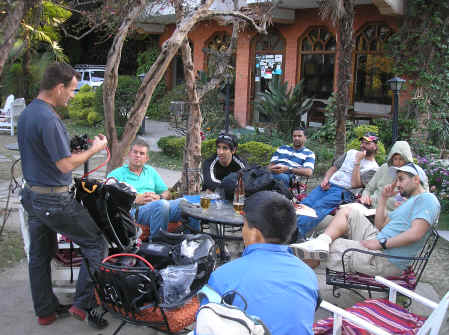 |
| Team receiving instructions on oxygen masks |
The benefits of studying human variation from this perspective across environmental clines are to see how and why populations living in higher altitudes experience longer lives and lower percentages of heart disease. It is possible that the higher altitudes strengthen the heart due to the hearts increased work and exercise required to pump blood and evenly distribute oxygen to the body, this results in increased heart stamina and longer endurance. I read an article that also suggests that people looking to train for long distance running or swimming would be better equipped for sea level challenges if they train in higher altitudes as the extensive heart and breathing stamina acquired would result in heightened endurance.
I do not believe that race should be used to understand the variation of people and their short term, facultative, developmental and cultural adaptations to their surroundings because the findings would not be accurate. There are many variations in any given race; therefore relying on one individual or individual group to account for an entire society would be inaccurate and false. Our genetic make up is relatively the same, across the board for all races, so we would all react similarly to environmental stressors, regardless of race. Viewing and researching the environmental influences and the populations’ adaption to these stressors would be a much more accurate determining factor of the environmental effects on humans, as the location and those particular environmental effects would conclude in specified results.

Great work with your blog post. Your blog was well researched and well written. I would imagine that is an A paper. You were clear and made good arguments I don't really have any criticism.
ReplyDeleteHi Lynnet. I really enjoyed reading your blog post. I found it interesting that dehydration is a common problem with higher altitudes and that in order to try to combat the effects of it, people make cultural adaptations such as changes in their diet in which they consume more water. I also like how you said that “The benefits of studying human variation from this perspective across environmental clines are to see how and why populations living in higher altitudes experience longer lives and lower percentages of heart disease.” I think that is a huge benefit that has the possibility of one day being able to help lots of people worldwide.
ReplyDelete-Cristina David
Excellent post with one caution. Yes, there is a developmental adaptation of more hemoglobin at higher altitudes, but this is not related to higher respiration rates, which is actually a horribly inefficient way to adjust to high altitudes. That's why it's only a short term adaptation.
ReplyDeleteDevelopmentally, populations at higher altitudes tend to have larger lungs (and have the barrel-shaped chests to prove it) and larger, more powerful hearts.
Great post. It was very informative! I agree that race is not a accurate way to compare human variations. My family is from Belize and we have all different races that live there. We have British, Mexican, Jamaican etc. It is one big melting pot. With race comes people bias prejudgments.
ReplyDeleteCool Post Lynnet
ReplyDeleteIt would be even better if you had added some credits for the pictures :-)